| With
ever increasing building costs, the requirement for
rapid building, rising energy costs and greater awareness
of global warming and energy conservation as an important
aspect of building design, expanded polystyrene (EPS)
is becoming increasingly used in modern day construction.
ADVANTAGES
OF EPS IN BUILDING
EPS
consists of 98% air and has long been used as a thermal
insulator in a number of applications. The insulating
ability of EPS makes it an ideal material for energy
efficient building products particularly when combined
with its other properties:
•
Lightweight making
it easy to transport and install;
•
Moisture resistant
increasing water penetration resistance;
•
Sound absorbency which
increases sound insulation particularly when used in
combination with harder building materials such as concrete;
•
Safe to use. EPS is
non toxic, does not contain CFCs,
can be 100% recycled, does not harbour micro-organisms,
is odorless and non-allergenic;
•
Versatile in
that it can be moulded, shaped and cut into virtually
any shape or pattern. This allows the cost effective
production of numerous decorative building products
such as mouldings and cornices;
•
Fire retardant. All EPS used in
ABP's building products is fire retardant and will not
propagate or contribute to the spread of fire
•
Long lasting.
EPS does not rot or degrade over time and remains dimensionally
stable so EPS building products will remain fully functional
for the life of any building in which they are used.
Expanded
polystyrene scores on fire safety
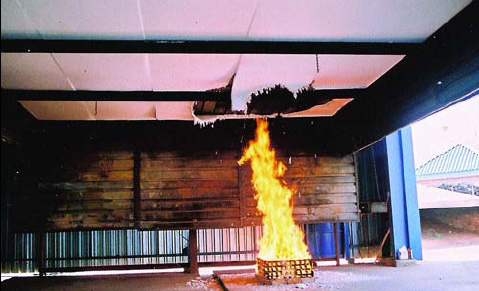
Recent tests have confirmed the fire retardant properties
of FR grade expanded polystyrene (EPS) thermal insulating
board. The key finding of the tests is that, in a fire,
EPS does not support the spread of flames.
“Architects and specifiers can now confidently
incorporate EPS in designing energy-efficient and cost
effective building solutions,” says Mike Myers,
Chairperson of EPSASA, the Expanded Polystyrene
Association of South Africa.
The tests, commissioned by EPSASA, were conducted by
Firelab cc, at the Council for Scientific and Industrial
Research (CSIR). They were carried out in line with
the protocol defined in SANS 428:2006 – “Fire
performance classification of thermal insulated building
envelope systems”.
SANS 428 covers the fire safety evaluation requirements
for thermal insulated building envelopes, such as under
roof and side-cladding insulating materials, liners,
insulated wall and roof panels, insulated ceilings and
insulated wall and ceiling coating systems.
This testing protocol requires that large-scale fire
testing of thermal insulation materials (SANS 10177:11)
must be done in a facility that simulates the real-world,
end-use conditions in which the product is typically
installed.
EPS boards of 80mm thickness, FR (fire retardant) grade,
and without any facing material, were used in all the
tests.
Myers comments that this is the material typically specified
for building insulation. EPSASA generally recommends
80mm to 100mm EPS board for ceiling and roof applications,
depending on relevant climatic conditions.
He adds that continuous improvements in FR grade EPS,
in the polystyrene raw material, and fire Retardant
properties and processing have now produced a material
that is classified as fire safe.
The Firelab assessment entailed a series of three tests
to evaluate the material’s fire propagation properties
in different applications: under- roof without a sprinkler
extinguishing system; under-roof with a fixed sprinkler
system using slow response sprinkler heads; and in vertical
side-cladding applications.
The test results show that although EPS does deform
and melt in proximity to fire, it does not actually
catch alight: the material simply disintegrates into
small snowflake-like fragments.
The
test report concludes that: “From a fire safety
point of view, the FR grade EPS thermal insulation system,
as tested under specific test conditions, may be used
as part of the thermal insulated building envelope in
all industrial and commercial buildings as an under-roof
and side-cladding insulation material, both with or
without sprinklers.”
It is nonetheless important to note that these test
results do not relate to fire resistance, which entails
different testing criteria and testing methods. Furthermore,
factors such as adequate roof ventilation and/or sprinkler
protection should be considered in individual installations,
taking account of the specific wall and roof configurations,
to ensure the fire-safe design of any building, according
to SANS 10400:T.
When selecting EPS thermal insulation systems, specifiers
may request a copy of the Firelab test report or it
can be viewed at www.epsasa.co.za. Suppliers should
be asked to verify their products’ conformity
to the test materials. In due course, EPSASA will be
issuing certificates of conformance to members supplying
test equivalent products.
EPS FR grade – Fire performance classification
code The test report classifies EPS FR grade in terms
of the SANS 428 classification code for fire performance
(which is required to appear on all packaging and data
sheets of thermal insulating building products and systems)
as follows: B / B1 / 2 / H&V. This code relates
to the SANS 10177 protocol of testing. The code signifies:
B – a combustible material; B1 – no flame
spread; B1 & B2 – suitable for use in all
occupancies except for the proviso listed in SANS 10400:T;
H&V – suitable for use in both horizontal
and vertical applications.
AAAMSA Group EPSASA - Expanded Polystyrene Association
of South Africa
Tel: 011 805 5002
|